By Joseph Thomas
Nov. 6, 2024
“I don’t really know what to do with this, so I’m just going to put it out there: Martin Skort.”
I recently said this at a comedy open mic at Tony’s Trophy Room in Collierville, Tennessee, holding multi-colored index cards containing varying levels of nonsense that, if nothing else, make me smile.
Is it the best joke I ever wrote? I hope not. Does it make me giggle? It really does.
That joke stemmed from a moment when I saw legendary comedy actor, Martin Short, on television and thought the name change sounded funny, both because of the shorts/skirt combinations that were popular in late ‘90s and early 2000s and because K sounds are generally funnier than other letters. Once the words were out, people’s minds would create an image on their own and find it funny.
I have no idea if that is what happened, but one can hope.
It was a moment of passing silliness—brief and insignificant—but those moments are some of my favorites.
Dumb jokes are important. They help us through hard times. They bring us closer to the people around us. They build relationships. And they tear through the bad things in life.
Let me be clear, though—being silly is not the same as being dismissive. It is not ignoring the bad. It is a way of responding to it.
I remember Al Gore appearing on The Daily Show once and praising host Jon Stewart for being a “court jester,” explaining that they were the only people who criticize the king and live. The reason? They disarmed him with laughter.
Laughter can be a most subversive form of protest. Once, in an interview with Spiegal International, film director and writer, Mel Brooks, defended his use of Adolf Hitler jokes saying, “By using the medium of comedy, we can try to rob Hitler of his posthumous power and myths.” This belief is one reason Brooks famously made Hitler the butt of several jokes in the 1967 film “The Producers” and again later in the Broadway musical of the same name.
His thinking was simple: laughing at a terrible person or thing weakens the effects of that person or thing. It is difficult to hold power over people when they do not take you seriously.
While speaking truth to power is vital, silliness is also good for us as individuals. Laughing creates endorphins that, to put it in scientific terms, tell our brains to make us feel better. It’s like Harvard Law student, Elle Woods from the 2001 film “Legally Blonde” famously said, “Endorphins make you happy. Happy people don’t shoot their husbands. They just don’t.”
Or, if you are looking for a slightly more reputable source, the Mayo Clinic’s website explains that laughing can relieve stress and ease tension in the short-term, and can improve immunity, relieve pain and improve mood over time, so while laughter may not be the best medicine, as the old saying goes, it can be a medicine.
In my line of work, laughter is essential both for the clients and for my fellow professionals. The ability to laugh helps all of us through rough periods, and those endorphins that Woods referenced bring light to darkness. My professional goal is to provide, or at least welcome, laughter to the people around me to brighten the surrounding moments.
Oh, by the way, I am a funeral director.
Laughing emboldens grieving people to look their sadness, fears and even their own mortality in the face with confidence to overcome, even if only for a moment. That moment can begin to shape the way they view the future, and enough of those moments will change their views completely.
This all leads me to something I heard earlier this year while listening to an episode of comedian Mike Birbiglia’s “Working it Out” podcast. His guest began discussing a book called “Four Thousand Weeks: Time Management for Mortals” by Oliver Burkeman. The title of the book stems from fact that human beings live an average of 4,000 weeks, give or take, in a lifetime.
I don’t know about you, but to me, that’s not a lot of weeks. Eighty-something years sounds like a long time, but 4,000 weeks does not, especially once I realized I’m presently sitting at somewhere around 2,200 weeks.
Life is shorter than I thought. Why would I want to take so much of it being overly serious or angry or stern? Why would I not want to laugh and have fun at every opportunity, even (or especially) in my criticisms and protests?
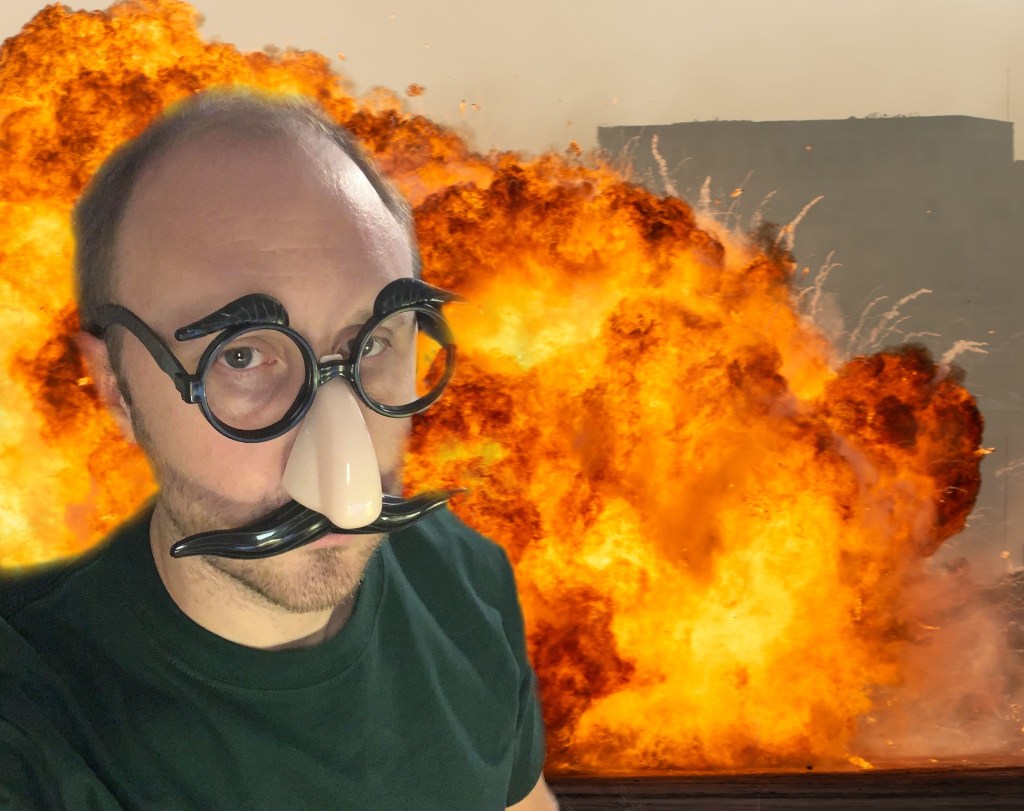
So I will continue to make stupid jokes. I will not shy from puns, intended or otherwise. I will take photos of myself like the one above just because I think they are funny. And I encourage everyone to do the same.